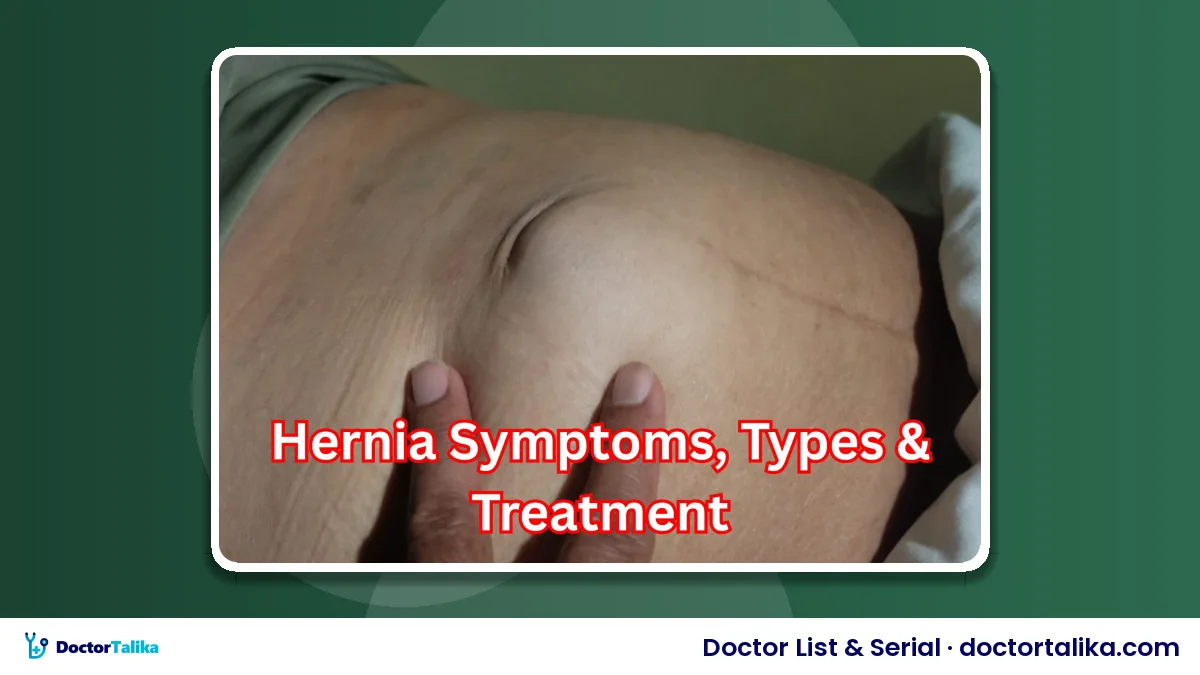
Hernias are a frequent health problem and can affect anyone, young or old. One forms when an organ or tissue inside the body squeezes through a weak point in the muscle or connective tissue around it. Some hernias cause no pain and little harm, but others can become seriously complicated without treatment. This article walks you through hernia symptoms, types & treatment, as well as the causes, risk factors and ways to prevent one.
What Is a Hernia?
With a hernia, fatty tissue or part of the intestine bulges out through a weakened section of muscle or the abdominal wall. You can often see it as a lump, particularly when you strain or pick up something heavy. The belly and the groin are where hernias show up most often.
Common Signs of a Hernia
Hernias differ in how big and how serious they are. Some do not hurt at all, while others can be quite uncomfortable.
Usual Hernia Symptoms:
- A lump or swelling in the groin, the belly or close to the navel
- Pain or discomfort, mostly when you cough, bend or lift
- A heavy or pressing feeling in the abdomen
- A burning feeling or weakness at the spot
- Sometimes nausea or vomiting, when the hernia is strangulated
Important: A hernia that gets stuck (incarcerated) or loses its blood supply (strangulated) needs emergency care.
Types of Hernia
Hernias are grouped by where they appear and why they happen. These are the types seen most often:
✅ 1. Inguinal Hernia
- The type seen most often
- Forms in the groin
- Men get it more often than women
✅ 2. Umbilical Hernia
- Shows up close to the belly button
- Often seen in babies, though adults can get it too
✅ 3. Incisional Hernia
- Develops where an earlier surgical cut was made
- Results from scar tissue that has become weak
✅ 4. Hiatal Hernia
- Part of the stomach moves up through the diaphragm into the chest
- May lead to heartburn and acid reflux
✅ 5. Femoral Hernia
- Forms a little below the groin
- Women get it more often
- Has a greater chance of strangulation
✅ 6. Epigastric Hernia
- Shows up between the chest and the belly button
- Generally small, yet it can be uncomfortable
Why Do Hernias Happen?
Knowing what causes a hernia makes it easier to prevent one or catch it early.
Frequent Causes:
- Straining to pass urine or stool
- Long-lasting sneezing or coughing
- Lifting heavy things the wrong way
- Being obese or putting on weight quickly
- Smoking or a poor diet, both of which weaken tissue
- Having had surgery on the abdomen before
- A weak abdominal wall present from birth (congenital)
How Doctors Diagnose a Hernia
Most hernias are found with a simple physical check. The doctor may ask you to stand and then cough or strain so the bulge shows. Sometimes extra tests are advised.
Ways to Diagnose:
- Physical exam, the first step and the one used most
- Ultrasound, to find small or internal hernias
- CT scan or MRI, for hidden or complicated hernias
- Endoscopy, used to diagnose hiatal hernias
Treatment Choices for Hernia
How a hernia is treated depends on its type, its size and how bad the symptoms are. A small hernia that does not hurt may simply be watched, but most need to be repaired with surgery.
1. Watchful Waiting
- Works for small hernias that cause no pain
- Regular check-ups to see whether anything changes
2. Treatment Without Surgery
- Using a truss or hernia belt for short-term relief
- For hiatal hernia, changing daily habits:
- Stay away from spicy food
- Have smaller meals
- Do not lie down right after a meal
3. Surgery (Hernia Repair)
a) Open Hernia Surgery
- The surgeon makes a cut over the hernia
- The bulge is pushed back into place and the muscle wall is mended
b) Laparoscopic Surgery
- A minimally invasive method
- Done through tiny cuts with the help of a camera
- Less pain and a quicker recovery
Today's hernia operations are safe and work well, and the hospital stay is short. Most people are back to their usual routine in a few weeks.
For specialist hernia care in Bangladesh, see our Best Hernia Surgeon in Dhaka list of experienced surgeons and nearby hospitals.
Who Is More Likely to Get a Hernia?
- Men, particularly for inguinal hernias
- Older people, as muscles weaken with age
- People with obesity
- Anyone with long-term constipation or cough
- Pregnant women
- People whose family members have had hernias
Is It Possible to Prevent a Hernia?
You cannot prevent every hernia, but healthy habits lower the chance of getting one:
Prevention Tips:
- Lift correctly or avoid heavy loads altogether
- Keep your weight in a healthy range
- Eat plenty of fiber so you do not get constipated
- Stop smoking to avoid coughing and weak tissue
- Exercise regularly to build strong abdominal muscles
When to Get Medical Help
Go to a doctor straight away if you have:
- Sudden, strong pain in the groin or belly
- A hernia that turns red or tender, or cannot be pushed back
- Vomiting or nausea along with a hernia bulge
Waiting too long to treat a strangulated hernia can put your life at risk.
FAQs: Hernia Symptoms, Types & Treatment
1. Will a hernia disappear by itself?
No, a hernia does not heal on its own. Small ones can be watched, but most end up needing surgery.
2. Is it dangerous to have hernia surgery?
Today's hernia operations are safe and very successful, particularly when performed laparoscopically.
3. How can I tell if I have a hernia?
See a doctor if you find a lump in your groin or belly that stands out more when you strain or stand up.
4. How long does it take to recover after hernia surgery?
Light activity is usually possible after 1–2 weeks, while heavy activity takes about 4–6 weeks.
5. Where in Bangladesh can I get a hernia treated?
Browse reliable doctors and hospitals for hernia care on our Hernia Surgeon page.
Final Words
A hernia can look like a small problem, yet without treatment it may cause serious trouble. Knowing the hernia symptoms, types & treatment helps you spot it early and manage it well. If you or a loved one has signs of a hernia, see a doctor without delay. Timely surgery brings lasting relief and keeps complications away.

Doctor Talika (ডাক্তার তালিকা) বাংলাদেশের বিশেষজ্ঞ ডাক্তার, হাসপাতাল ও ডায়াগনস্টিক সেন্টারের তথ্য এক জায়গায় তুলে ধরে। আমাদের লেখা শুধু সাধারণ স্বাস্থ্য সচেতনতার জন্য — চিকিৎসার সিদ্ধান্ত নিতে অবশ্যই রেজিস্টার্ড ডাক্তারের পরামর্শ নিন।